

Does My Child
REALLY Need
Myopia Control?
The questions parents ask before deciding whether to start.
Your child is told they are nearsighted. Maybe the prescription is only -0.50. Maybe it changed by 0.75 this year. Maybe you're wondering if you should spend money on myopia control--or simply get regular glasses and just wait.
Let's Talk🙂
YOU DON'T HAVE TO DECIDE TODAY. Start by understanding your child's risk, options, and what detailed monitoring can tell you.
01
My child is only -0.50. Do we really need myopia control?
A -0.50 D prescription may look small—but it is already considered myopia.
The International Myopia Institute ( IMI ) defines myopia as a spherical-equivalent prescription of -0.50 D or more myopic when accommodation is relaxed.
But the prescription alone doesn't tell us whether your child is likely to progress.
We also want to know:
-
How old is your child?
-
When did the myopia begin?
-
Has the prescription changed since the last examination?
-
How quickly has it changed?
-
Does either parent have myopia?
-
How much time does your child spend outdoors?
-
How much close work or screen-based activity do they do?
-
Is there evidence that the eye is continuing to elongate?
-
Are there other factors that increase their risk of progression?
A younger child with newly developed myopia and a history of rapid progression is a very different situation from an older child whose small prescription has remained stable.
So -0.50 D shouldn't automatically be dismissed as "too little to worry about."
02
My child's prescription increased by 0.75D this year. What should I do?
A change of 0.75 D in one year is a meaningful change, particularly in a younger child.
For context, large longitudinal studies have found that progression can be substantial in school-aged children, with faster progression generally occurring at younger ages.
It doesn't mean your child's eyes are "damaged."
It also doesn't mean that a particular treatment is automatically required.
But a bigger and more useful question is:
"Why did my child's prescription change by 0.75 D, and can we slow further progression?"
A rapidly changing prescription is a reason to investigate or inquire further with a myopia management specialist.
03
Should we just get regular glasses?
Regular glasses are important --they correct the blurry vision caused by myopia. But they don't specifically target the progression of myopia.
Myopia control glasses are designed to do both: help your child see clearly and also address myopia progression.
The more important question to ask yourself is: "Whether vision correction alone is enough for my child, or whether I should also consider an approach intended to slow progression."
04
Is myopia control actually worth the cost?
There isn't one answer that fits every child and family.
Cost is a legitimate part of the decision. In the IMI's 2025 global survey, cost to the patient remained the most frequently reported barrier to prescribing myopia interventions.
The goal isn't to convince every family to spend more money.
The goal is to make sure parents understand what they're paying for, what the potential benefit is, and what alternatives exist.
The benefit of myopia management is slowing the rate of progression -- not a guarantee that the prescription will stop changing.
The decision depends on your child's individual risk factors, lifestyle, and your family's budget.
05
Can we just monitor for now?
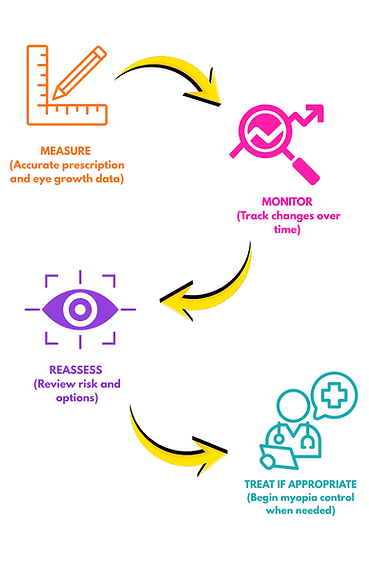
Active monitoring is not the same as doing nothing. It means keeping a close eye on your child's eye health and progression so we can make informed decisions about treatment, if and when it's needed.
We look at the child's current prescription and compare it with previous measurements.
If available, axial length can provide additional information about eye growth.
We then reassess whether the child appears stable or whether progression is continuing.
The IMI recommends considering factors such as age, baseline refractive error, progression rate, safety, compliance and cost when determining management strategies.
The important distinction:
Passive monitoring:
"Come back next year and we'll see what the prescription is."
Active monitoring:
"We're going to track your child's prescription and eye growth and decide together whether intervention is appropriate."
If your child's myopia is changing quickly, waiting another year without a plan may mean losing valuable information about the rate of progression.


What Other Questions Do Parents Ask?
Here are some of the most common questions we hear from families:
Does myopia control actually work?
Several types of myopia-management treatment have evidence showing that they can slow progression.
The evidence includes:
-
specialized spectacle lenses
-
multifocal/dual-focus contact lenses
-
orthokeratology
-
atropine
-
and other emerging approaches
Myopia control does not mean:
"Your child's prescription will never change again."
It means:
"The treatment is intended to slow the rate at which myopia progresses."
That is a much more realistic expectation.
Can myopia control reverse my child's prescription?
No.
Current myopia-management treatments are intended to slow progression, not reverse established structural myopia.
If your child starts at -1.00 D, for example, the goal isn't necessarily to make them -0.25 D.
The goal is to reduce the amount and/or rate of progression compared with what might otherwise occur.
That distinction is important when evaluating whether a treatment is working.
Is myopia control safe?
Safety depends on the treatment.
Different approaches have different considerations.
Myopia-control spectacle lenses are non-invasive and generally involve the same basic process as wearing ordinary glasses.
Soft myopia-control contact lenses require appropriate hygiene, fitting and follow-up because contact-lens wear carries risks such as corneal infection.
Orthokeratology involves wearing specially designed hard lenses overnight and requires very careful fitting, hygiene and monitoring.
Atropine is an eye medication and can have side effects, with higher concentrations more likely to cause light sensitivity and near-vision effects.
The right question isn't simply: "Is myopia control safe?"
It is: "What are the benefits, risks, inconvenience and expected results of each option for my child?"
What happens if I don't treat my child's myopia?
Every child is different.
Some children progress relatively slowly. Others progress considerably during childhood.
The younger a child develops myopia, the more years of eye growth they potentially have ahead of them. Earlier onset is associated with a greater likelihood of reaching higher levels of myopia later in life.
Higher myopia is associated with increased risk of several eye conditions later in life.
If your child's myopia is progressing, slowing that progression may reduce the amount of myopia they ultimately develop and may reduce their lifetime risk associated with higher levels of myopia.
Does my child NEED an axial length measurement?
It can be very useful.
Your prescription tells us about the eye's optical focusing error.
Axial length tells us about the eye's physical length.
Because myopia is commonly associated with excessive axial elongation, measuring axial length can provide another useful measurement when monitoring progression.
The IMI's 2025 instrumentation update highlights axial-length measurement as an increasingly important tool in myopia management.
However, axial length should not be viewed in isolation.
A child's clinical picture may include:
Prescription + axial length + age + previous progression + family history + lifestyle + eye health
Together, these measurements provide a more complete picture.
Is screen time causing my child's myopia?
It's more complicated than simply blaming screens.
Modern childhood involves a lot of close-up visual activity, including reading, homework, tablets, computers and phones.
Rather than focusing on one device, it is more useful to consider your child's overall visual environment:
-
regular breaks during prolonged near work
-
reasonable working distance
-
adequate lighting
-
time outdoors
-
and avoiding long uninterrupted periods of close work.
Screen use shouldn't be presented as the single cause of myopia.
Does my child need myopia control glasses, contacts, ortho-k, or atropine?
There isn't one treatment that is right for every child.
Treatment selection should consider:
-
age
-
prescription
-
rate of progression
-
eye health
-
binocular vision
-
lifestyle
-
ability to comply with treatment
-
comfort
-
cost
-
and family preferences
The 2025 IMI evidence review supports several established treatment categories, rather than identifying one universal treatment for every child.
A good myopia-management consultation should therefore be about your child's options, rather than starting with a particular product.
Can outdoor time help my child's myopia?
Yes—outdoor time is an important part of healthy visual habits.
Research supports outdoor exposure as a protective factor against developing myopia. The evidence that simply increasing outdoor time will substantially slow progression once a child is already myopic is less strong.
So believing that more outdoor time will stop myopia progression is a myth.
Outdoor time is a healthy habit and an important part of myopia prevention, but it shouldn't automatically be considered a replacement for myopia management when a child's myopia is progressing.
Is myopia genetic?
Yes--but only partly.
Having both parents myopic raises the risk of their children developing myopia. However, environment also matters strongly, especially limited outdoor time and prolonged near work/education. So myopia is genetic in predisposition, not purely inherited.

What Does Myopia Management Actually Involve?
-
Comprehensive Eye Exam to update your child's vision, check eye health, and assess risk factors
-
Myopia Control Consultation to review previous prescriptions and look for progression, assess risk factors like age, family history, lifestyle
-
Axial Length Measurement to gather baseline and future eye growth data
-
Discuss Options to find the best fit for your child
-
Treat and Monitor with ongoing follow-ups and treatment adjustments when needed

There Isn't One Treatment For Every Child
.png)

The best choice depends on your child's needs, lifestyle, and preferences.